



What Generative AI Gets Wrong About Corporate Strategy
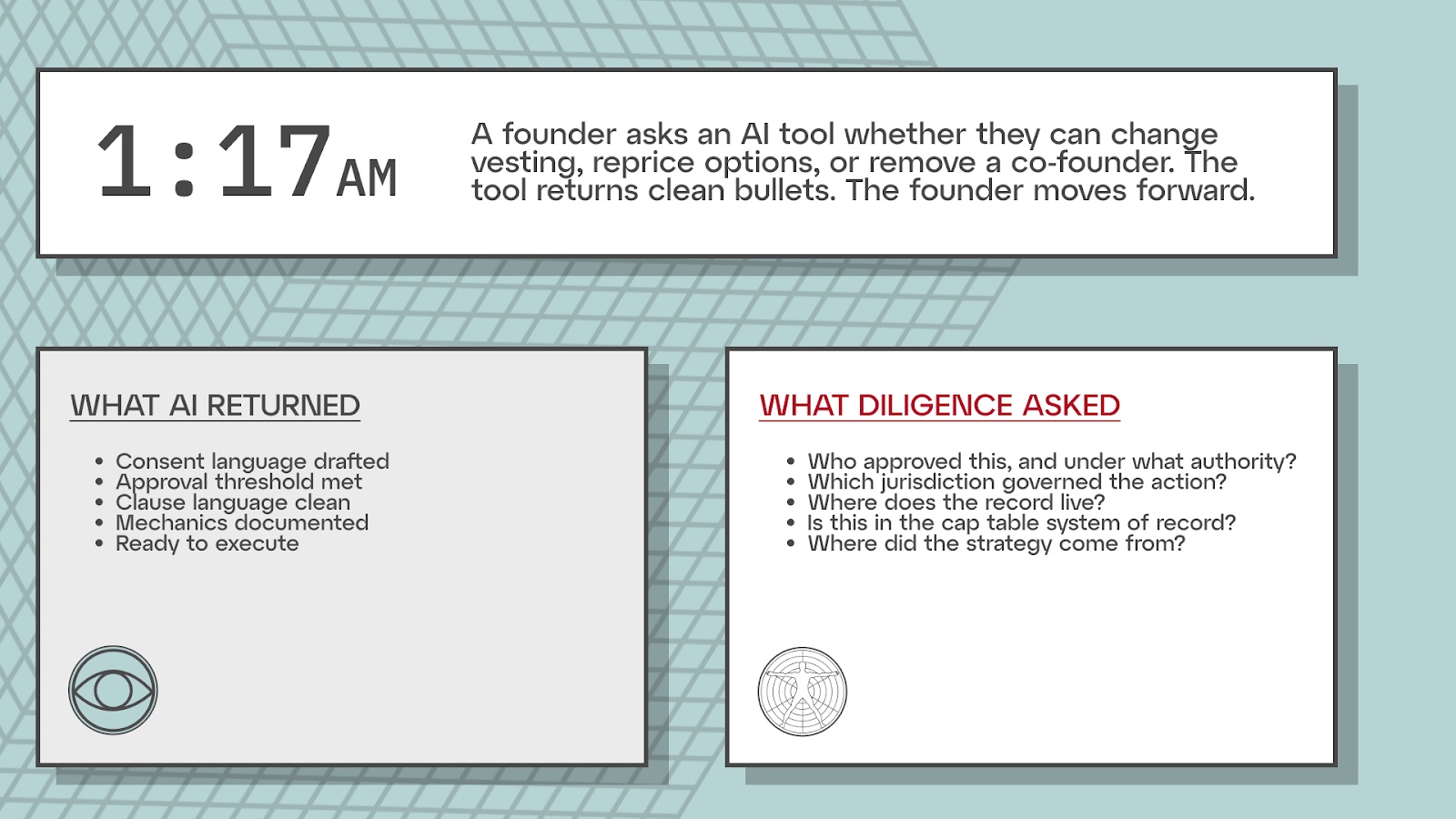
At 1:17am, a founder asks their AI tool whether they can change vesting, reprice options, or remove a co-founder. The tool returns clean bullets and consent language. It looks professional. The founder moves forward.
The problem surfaces later, under time pressure, when diligence asks who approved the change and under what authority. The only answer available is a folder containing three cap tables explained by three chat threads. That is a rework problem with a dispute attached.
Generative AI has earned a place in the legal workflow. It compresses time on formatting, accelerates first-draft turnaround, and handles the kind of clause-level language work that used to sit in a queue for days. Most sophisticated teams are already using it, and they are right to.
The risk is a specific misclassification that happens under pressure: treating AI-assisted drafting as a substitute for the approval infrastructure that makes corporate actions defensible. That misclassification rarely surfaces in the draft itself. It surfaces in diligence, in a dispute, or in a regulatory review, when the question is not what the document says but who authorized it, under what authority, and where the record lives.
In March 2026, the Delaware Court of Chancery produced a ruling that global institutional counterparties will be referencing for years. A CEO facing a nine-figure earnout obligation turned to a generative AI tool for restructuring strategy after bypassing his own legal team. The tool generated a detailed multi-stage corporate strategy that he executed. The strategy failed, and the AI-generated paper trail became the evidentiary record the court used against the company.
The ruling matters less as a cautionary tale and more as a signal about where institutional and judicial scrutiny is now focused. Courts and counterparties are not just reading the documents anymore. They are asking where the strategy came from, whether it was validated, and whether the approval chain is legible. For any team approaching a raise, a token launch, or a significant structural change, that is the operating environment.
Why AI Can Draft a Document but Not a Record
Corporate strategy in a distributed Web3 structure is almost always a bundle of approvals, not a single decision. Adjusting vesting, issuing advisory equity, amending round economics, restructuring a multi-entity stack: each of these is a formal corporate action that moves through a specific approval hierarchy before it is valid. The document is the record of that process, not the process itself.
Generative AI tools produce text with precision and speed. What they cannot produce is proof: which facts governed the decision, what the controlling document hierarchy was, which jurisdiction applied, and whether the right principals authorized the action. In equity and governance work, that gap between a well-drafted document and a defensible corporate record is where the exposure lives.
For teams operating across jurisdictions, with contributors in multiple countries, investors across time zones, and entities in more than one regulatory environment, the approval chain carries more complexity, not less. The sophistication of the structure raises the standard for the record.
Where the Structure Comes Apart
Confident Language, Wrong Document. Generative AI tools are calibrated to be effective at producing mechanics about approval thresholds, authority hierarchies, and document controls that sound convincing but may not map to your actual document stack. Bad language in equity documents does not look bad until it costs you. Challenges appears later, when the action is challenged and the controlling clause says something different from what the AI assumed.
Confidentiality Leaves the Room With the Input. SAFEs, token warrants, cap tables, side letters, and investor terms are regularly used as AI inputs. Beyond the immediate confidentiality risk, this creates an evidence trail if the relationship turns hostile or privilege becomes contested. In Web3, where the line between internal and public-adjacent communication is already thin, that exposure is amplified.
The AI Doesn't Know What It Doesn't Know A generative AI tool cannot reliably map a specific set of facts to the controlling jurisdiction, required approvals, and document hierarchy for a distributed structure. More importantly, it cannot identify when the facts it has been given are incomplete. The output will be confident regardless. The cost of accepting that confidence is re-papering, migration, and the kind of investor skepticism that is difficult to withdraw once it has been expressed in a diligence call.
Well-Formatted Is Not Well-Authorized Turning messy clauses into clean language, comparing redlines, rewriting definitions for internal alignment: these are genuine strengths, and teams that use AI for exactly this work are using it well. The misclassification happens when that demonstrated competence is taken as evidence that the same system can generate reliable answers to questions of strategic authority. A document that has been well-formatted is not a document that has been properly authorized.
The Line That Matters in Practice
AI-generated drafts have a legitimate place in the workflow as initial inputs to a structured review process. They do not belong as the rationale for a corporate action, the source of record for a governance decision, or the basis for a cap table change that will be reviewed by institutional counterparties.
The teams that manage this well treat AI output the way they treat any preliminary analysis: useful as a starting point, requiring validation against the actual document hierarchy, and never the final word on what is authorized. Every equity-affecting action moves through a documented approval path. Every structural decision generates a record that can be explained, sourced, and defended independently of the tool that helped draft it.
For teams approaching a raise or a token launch, the question worth asking now is whether the structure as it stands could be explained coherently under institutional scrutiny: not just the documents themselves, but the decisions behind them and the approval chain that produced them. That is the standard that institutional capital, and increasingly the courts, are applying.
If This Sounds Familiar, Start Here
If any part of this sounds familiar, the following is a useful first pass for identifying potential gaps before bringing your docs to a professional for a proper review. The steps below do not constitute and are not a substitute for professional advice. Automation and drafting: where AI earns its place
AI tools work well for contract formatting and cleanup, clause comparisons and redline summaries, plain English explanations for internal alignment, and drafting standard or boilerplate clauses. In all of these uses, the tool functions as a drafting assistant. Conclusions should move into an enforceable agreement, a cap table system, or an approval workflow where a qualified person is accountable for the final call.
Actions that require experienced review and a traceable approval path
- Issuance, vesting changes, and repurchase terms
- Option pool creation, dilution or resizing
- SAFEs, SAFTs, token warrants, agreements and side letters
- Board composition, observer rights, and signature authority
- Token commitments that investors treat as economic rights
A quick audit trail diagnostic
Before the next equity-affecting action, it is worth confirming that the following are in place:
- A single cap table source of truth, with no parallel spreadsheets
- A board consent log with dates and signers
- A signature packet folder containing final PDFs only
- A change log for any action that touches ownership or control
- AI output filed as a draft input, not as decision rationale
If the record can be explained in a short conversation with documents that reconcile cleanly, it is in good shape. If not, that is the gap a proper review will address.
FAQ
What makes GVRN different from using an AI tool or a generalist law firm? GVRN combines practitioner-level legal expertise with deep institutional experience across the jurisdictions that matter most to Web3 founders: BVI, Cayman, Singapore, Delaware, and beyond. The team has worked on the structural and regulatory challenges that most firms encounter only occasionally. That depth means your situation is understood at the level it actually operates, not pattern-matched to a template.
Who will I be working with at GVRN? Real people with real expertise. GVRN is not a document automation platform. Engagements are handled by practitioners who have worked across institutional capital raises, token launches, and cross-border entity design. When your structure has a complication, the conversation starts from competence, not from a discovery process.
Can GVRN advise on jurisdiction selection and cross-border entity structure? Yes, and this is where institutional experience is most valuable. The right jurisdiction depends on your investor profile, token mechanics, operational footprint, and banking relationships. GVRN works through that picture with you and structures accordingly, rather than defaulting to whatever is fastest or most familiar.
How does GVRN approach pre-TGE advisory? With the same level of scrutiny that institutional counterparties will apply. GVRN reviews token structure, entity architecture, contributor agreements, and distribution mechanics before a fixed timeline forces reactive decisions. The goal is a structure that holds under diligence, not one that needs to be explained away during it.
This guide is general information, not legal advice. Structures are confirmed with licensed counsel during setup.


