

Is Your Cap Table a Hallucination? Auditing AI for Protocol Structuring
You cannot retrofit legal provenance during launch week. If your AI-assisted drafting lacks an immutable audit log today, your TGE is built on a hallucination. Here is why "Shadow AI" structuring is the single greatest risk to your protocol’s continuity.
Counsel changes mid-deal more often than founders plan for, and when it happens, the incoming team inherits the output without the process. A lead attorney leaves eight weeks into a Series A. The new partner runs a standard review of the data room, finds nothing obviously wrong, and moves toward closing.
What they cannot see is that a defined term inconsistency flagged by the original attorney lived in a chat thread, not in a document. The AI had treated 'Token Allocation' and 'Token Rights' as interchangeable across the SAFE, the token warrant, and the governance side letter. The flag never made it into the record. The investor's counsel catches it in the final review. The close slips behind schedule by two weeks. The founder is now explaining a discrepancy to someone who is actively deciding whether to wire money.
The defensible way to use legal automation for protocol structuring is to treat every output as an auditable hypothesis. Validate it against benchmarked deal patterns, jurisdiction constraints, and a review trail that outlives vendors, law firms, and staffing changes. Run the method below weekly, not only when something breaks.
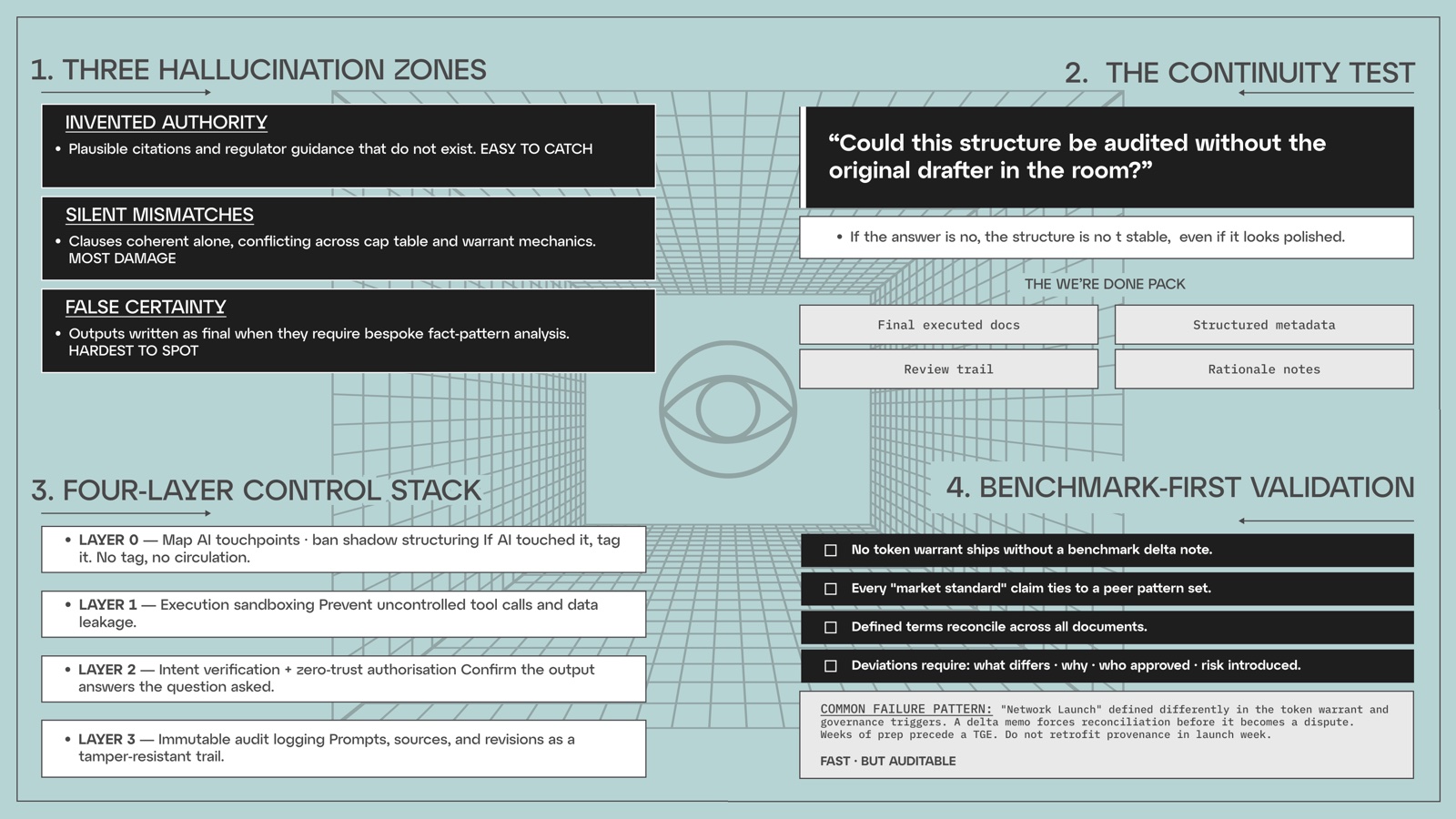
The three high-risk zones: invented authority, silent mismatches, and false certainty
In protocol structuring work, AI hallucinations cluster in three zones. They are operationally different, so your controls must be too.
- Invented authority: plausible sounding case law, regulator guidance, or “market standard” claims that do not exist.
- Silent mismatches: clauses that look coherent alone but conflict with the cap table, token warrant mechanics, or a control model in another document.
- False certainty: answers written as final when the issue requires bespoke analysis tied to your fact pattern.
In practice, invented authority is easiest to catch and easiest to ignore. If a draft includes a citation or regulator quote, it should be supported by a working link or an internal source reference before it moves forward. If the source cannot be opened or verified, the language does not work.
Silent mismatches do more damage because they survive review.
Imagine you are overseeing the construction of a state-of-the-art battleship. A ship is built in modules at different dry docks across the country.
The Hull Team (Governance) decides to upgrade the steel plating to 10 inches of thickness to meet a new safety standard. The update the blueprint and send it off.
The Engine Team (Warrant Mechanics) is building the power plant that must bolt directly onto that hull. Instead of looking at the Hull Team’s specific updated blueprints, they rely on industry standard specs for ships of this class.
Both sets of blueprints look perfect, and are signed off by master engineers. When the ship is finally assembled, the engine is lowered onto the hull and bolts are fired… only to miss because they don’t line up with the engine. In a calm harbor this is a multi-million dollar delay. In the middle of a storm, the engine vibrates loose, hull cracks and ship sinks.
Our team has seen “market standard” used as a substitute for the last signed version too often to count. A governance approval threshold changes in one document. The warrant exercise mechanics reference the old threshold because whoever drafted them was working from the previous version, not the current one. Both documents passed review. Both looked correct. The conflict lives in the gap between them, invisible until a counterparty needs to know who can authorize a material action and the two instruments give different answers. Reviewing each piece in isolation is exactly how this class of failure survives to closing.
AI is useful. First drafts, issue spotting, and redlines are legitimate productivity wins. The failure is false certainty: circulating outputs as if they are already coherent, jurisdiction-specific, and internally reconciled. Legal ops owns the blast radius because you own circulation.
AI-drafted clauses outlast the people who made them
When counsel goes dark mid-deal, you inherit artifacts: docs, redlines, and email threads with no clear owner. An AI-assisted draft without a sign-off trail does not stay provisional. It becomes the record. The clause stays because nobody can answer why it exists, and every new counterparty retrieves a slightly different story about what it means.
One question cuts through the whole problem: could a new counsel audit this structure in one hour, without calling anyone? If the answer is no, the structure is not stable. The operational requirement is not, “We have a PDF.” It is a clear overview, documentary evidence, and sign-off trail.
Could a new counsel audit this in one hour? If the answer is no, the structure is not stable.
The audit protocol: a four-layer control stack for automated counsel outputs
Layer 0. Map AI touchpoints and ban shadow structuring
Start with inventory. Every structuring decision that AI drafts, edits, summarizes, or “helpfully rewrites” counts: term sheets, SAFE side letters, token warrant definitions, board consents, foundation bylaws, investor FAQs, even internal memos that later get copy-pasted into documents.
Then require disclosure in the workflow: if AI touched it, tag it. No tag, no circulation. This gives you protection through provability.
Minimum policy (one line): AI-assisted drafting must be declared in the document header and routed through standard review gates.
With this policy, you are getting ahead of anonymous AI language in your documentation. The practical “why” is simple: if a clause becomes contentious later, provenance is the only way to avoid re-litigating your own drafting process.
Layers 1-4: sandbox, verify intent, authorize, log
Treat agentic drafting like production software. The control stack is already well described in the Layered Governance Architecture model:
- 1- Execution sandboxing: prevent uncontrolled tool calls and data leakage.
- 2- Intent verification: confirm the output actually answers the question asked.
- 3- Zero-trust authorization: restrict what the agent can pull, transform, and insert.
- 4- Immutable audit logging: preserve prompts, sources, and revisions as a tamper-resistant trail.
Layered governance is operationally feasible: research reports 93.0 to 98.5% tool-call interception, 96% end-to-end interception, and ~980 ms P50 latency.
For each high-impact clause, store source, owner, status, last approver, timestamp: treat clauses as controlled objects with lineage. This is the “how” that prevents a single good-looking draft from becoming a permanent, un-auditable dependency.
Interception ≠ correctness. Humans still own substance review and liability.
Benchmark-first validation: turning drafts into defensible structures
Replace market standard with peer-validated pattern
Benchmarking narrows variance; it doesn’t create precedent. There is currently no generally accepted standard and no legal precedent for many decentralization structures: so build a defensible record of decisions.
This is where benchmark-first validation becomes the center of the audit. Compare AI output to observed peer patterns across similar protocol types, fundraising instruments, and jurisdictions. Then require a delta memo for deviations: what differs, why it differs, who approved it, and what risk it introduces. The point is not conformity. The point is isolating intentional risk from accidental drift.
Rule: ship no token warrant without a benchmark delta note.
Common failure: “Network Launch” is defined one way in the token warrant and another in governance triggers. The delta memo forces reconciliation before it becomes a dispute.
- Tie every “market standard” claim to a peer pattern set; document deltas with owner including rationale.
- Reconcile defined terms across all documents.
- Timing is the constraint: weeks, sometimes months of prep precede a TGE: don’t try to retrofit provenance in launch week.
Make outputs survivable: the done-done pack legal ops should insist on
Define done-done as a packet that survives counsel churn: final docs, structured metadata, review trail, and rationale notes. The real value of Web3 incorporation services and corporate structuring tools lies in consistent generation plus traceable states and sign-offs, so continuity does not depend on a single inbox.
If you cannot run the full process, enforce a minimum viable version: clause-level source requirements plus one accountable reviewer who signs off before anything hits investors. This keeps your process benchmarkable and defensible even when timelines compress.
That is the standard for automated corporate counsel. Fast, but auditable.
SPEAK TO AN EXPERT: We’ll map AI touchpoints, set minimum controls, and deliver a benchmark-first checklist for your next SAFE, SAFT, or token warrant.
FAQ
How do I spot an AI hallucination in token warrant or protocol structuring drafts?
Run three checks. First, every legal citation must be supported by a legitimate source you can open. Second, defined terms must reconcile across the whole stack so definitions do not drift. Third, any “market standard” statement must map to a benchmark set or executed real-life examples, not model confidence.
What is the minimum audit trail legal ops should keep for AI-assisted legal automation?
Keep prompt, sources, circulated version, reviewer + timestamp, and a short rationale for non-standard terms. If you cannot reconstruct “who approved what, and why” quickly, you do not have continuity.
Does retrieval-augmented generation (RAG) solve hallucinations for legal drafting?
RAG reduces fabrication by grounding outputs in a verified repository, but it does not guarantee instrument fit, jurisdiction fit, or factual coherence. Treat RAG as error-rate reduction, not a replacement for accountable review.
How should legal ops handle shadow AI use in fundraising and structuring workflows?
Make disclosure mandatory: AI-assisted drafting must be labeled clearly and routed through the same review gates as human drafts. The governance problem is provenance.
What should I do if our counsel changes mid-deal and we suspect AI-generated clauses are in the stack?
Re-audit the high-impact documents first: term sheet, SAFE or SAFT exhibits, token warrant, and governance or control provisions. Require source-backed verification for each high-impact clause and reconcile definitions across the full set before recirculating. If you need a repeatable workflow, GVRN provides tooling that turns structuring and fundraising into tagged states with coordinated review, so the deal remains auditable even when counsel changes.
This guide is general information, not legal advice. Structures are confirmed with licensed counsel during setup.


